


If you are looking for the “best ERP software in 2026,” most generic listicles will give you the same tired corporate answers: SAP, NetSuite, Odoo, or Microsoft Dynamics.
But for scaling mid-market companies, technical founders, and operations leaders, the choice isn’t just about choosing a brand name or counting features. It is about an architectural philosophy: Are you buying a locked-down, shared cloud ecosystem, or are you investing in complete data sovereignty and code freedom?
In 2026, the ERP landscape has split cleanly down the middle, and the best system for your business depends entirely on who owns your environment.
The Mid-Market Dilemma: Bloat vs. Control
Most enterprise ERP platforms have doubled down on a multi-tenant cloud model. They sell you convenience, but hide the operational reality:
- Zero Code Customization: You are confined to basic UI adjustments or forced to write proprietary logic inside restrictive, closed-off scripting sandboxes.
- Forced Upgrades: When the vendor pushes an ecosystem update, your custom integrations risk breaking overnight because you don’t control the deployment schedule.
- Shared Resource Overhead: Your database queries share infrastructure pools with thousands of other companies. When their traffic peaks, your operational dashboards lag.
For companies that view their operational software as a competitive advantage rather than a utility, these constraints are growth bottlenecks.
Why ERPNext Leads the 2026 Architecture Shift
For businesses that require customized workflows, deep API integrations, or proprietary features, ERPNext has become the standout backend engine of choice. It succeeds because it rejects the limitations of traditional SaaS.
1. Total Code Sovereignty
Unlike closed-source platforms that lock you out of system directories, ERPNext is built on the open Frappe framework. If your operational logistics require custom pricing matrices, unique manufacturing pipelines, or deep warehouse automation, your development team has full liberty to build them. You are never forced to buy bloated third-party plugins just to modify basic business logic.
2. True Database Independence
A standard public cloud instance forces your data onto a shared global database cluster. ERPNext allows you to run a completely standalone environment. Your ledger entries, customer profiles, and supply chain records reside in an independent database structure—ensuring maximum data security and zero outside noise affecting your execution speeds.
3. Seamless Headless Scale
As headless digital infrastructure dominates in 2026, your ERP cannot just be a back-office tool; it must act as a lightning-fast data engine. Every single asset, document type, and table inside ERPNext natively exposes clean REST API endpoints. You can run high-volume web portals, mobile customer apps, or custom field tools directly against your core database without middleware layer failure points.
The Catch: Software Is Only As Good As Its Box
Here is the truth that open-source advocates ignore: ERPNext is an incredibly powerful engine, but running it on cheap, shared multi-tenant hosting will ruin the experience. If your background worker queues are cramped on an un-tuned global server, your automated pipelines and email notifications will bottleneck.
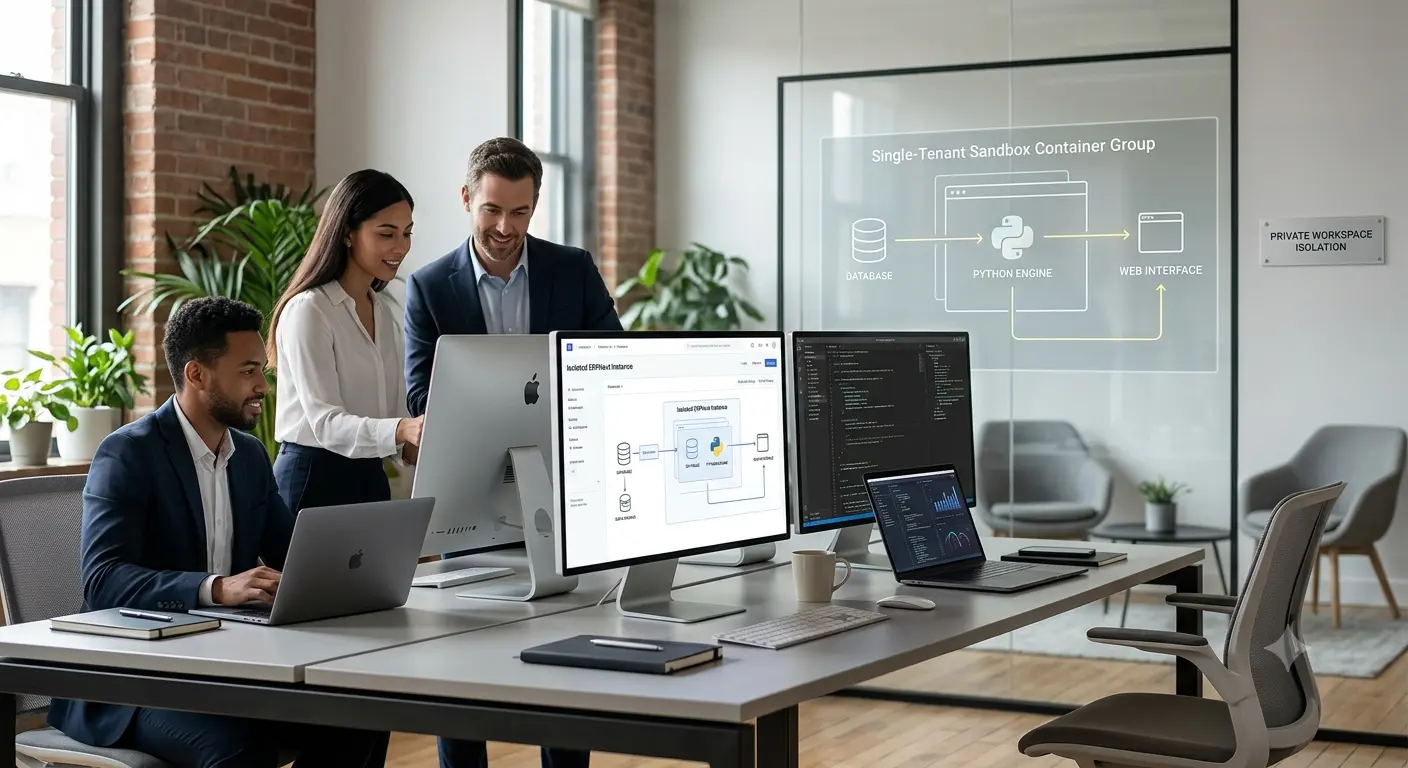
To win with ERPNext, your infrastructure must match its open architecture: absolute single-tenant isolation.
When you deploy a dedicated, boxed container sandbox instance, you unlock the true potential of the system. You get the agility of a modern open framework paired with the rock-solid performance of private server resource pools—giving you full developer terminal access, custom Git configurations, and absolute control over your operational future.