


A while back, a manufacturing company asked me to help them pick an ERP. They had a technical CTO who’d spent a weekend reading about open-source options and arrived at two names: ERPNext and Apache OFBiz.
His instinct leaned toward OFBiz. “It’s Java,” he said. “Enterprise-grade. Used by big companies. More modular.”
I told him: “You can have modular, or you can have live by summer. You probably can’t have both.”
He didn’t believe me at first. So we ran a small experiment. Two fresh VMs, one with ERPNext installed via our standard script, one with Apache OFBiz from source. I asked him to model a simple custom workflow: a purchase request that auto-generates a purchase order when approved by a department head. No coding, just configuration — ideally.
The ERPNext instance was ready and the workflow built (with native Workflow and a server-side script hook) before OFBiz had even finished booting its full component stack without errors.
That experiment saved the company six months and about $80,000 in developer burn. Here’s what we actually learned, beyond the architecture diagrams and Java marketing bullet points.
The Difference Is Not “Which Is Better.” It’s “What Are You Buying?”
Apache OFBiz is not an ERP in the way most businesses use the word. It’s an enterprise automation framework. It ships with a deep toolbox of data models, service engines, and e-commerce components, but it does not hand you a ready-to-use procurement dashboard, an HR payroll run, or a tax-compliant invoice template. It hands you the blueprints and the raw materials, then expects you to build the rooms yourself.
ERPNext is an operational ERP application. You install it, create a company, and you can literally start entering sales orders and printing invoices that same hour.
That distinction gets buried under phrases like “component-based architecture” and “highly decoupled service engine.” But in practice, it means everything.
Let’s Talk About the Actual Architecture — In Plain English
Both systems separate data definitions from business logic and presentation. That’s where the similarity ends.
ERPNext (Frappe Framework) runs on Python. When you add a custom field to a Sales Order, you’re changing a JSON document called a DocType. Run a quick bench migrate and that field becomes a real database column in MariaDB or PostgreSQL. Behind the scenes, Nginx and Gunicorn workers handle web requests, and a Redis queue processes background jobs like sending emails or generating reports. It’s a clean, modern web stack that a competent full-stack developer can understand in a couple of days.
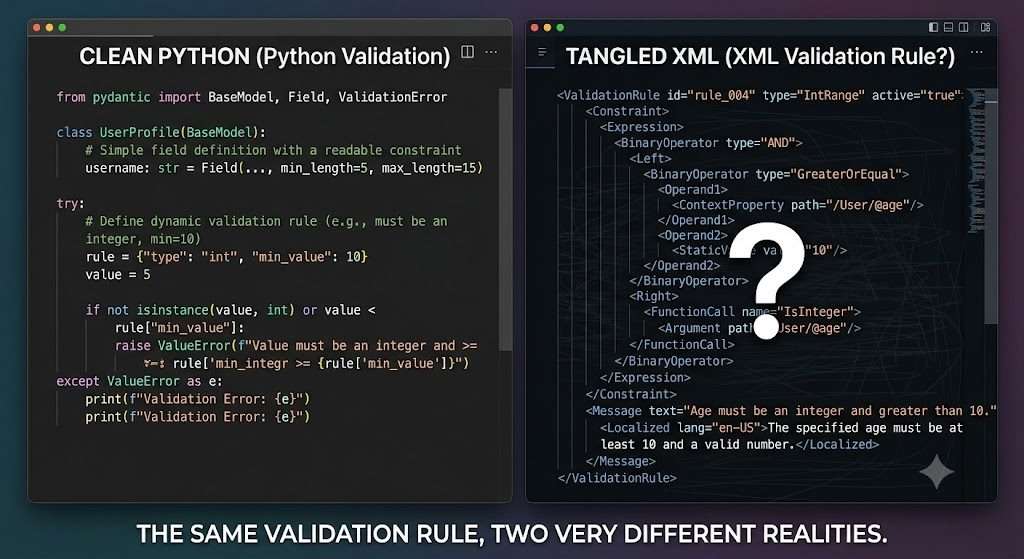
Apache OFBiz runs on the Java Virtual Machine, deployed inside Apache Tomcat. Business data structures aren’t defined in code files — they’re massive XML entity definitions. Business logic doesn’t live in controller classes you can easily trace; it sits in XML Service Definitions that reference Java or Groovy snippets. The whole thing is tied together by an internal service bus that orchestrates everything. It is powerful. It is also, to borrow a phrase from a client who tried to hire OFBiz developers, “a full-employment scheme for XML consultants.”
Imagine changing a field label. In ERPNext you edit a JSON value and migrate. In OFBiz you locate the correct XML entity file, understand its inheritance chain, modify the field definition, restart the relevant component, and clear several caches. Then you realize the label also exists in a UI widget definition in a different XML file, so you change that too. This is the reality that technical comparisons often gloss over.
Customization: Python Hooks vs. XML Ceremony
The Gemini comparison post I’m riffing off here talked about “declarative JSON definitions” versus “XML entity definitions.” That’s technically correct, but sterile. Here’s what it feels like on the ground.
Say you want a custom validation: “A Purchase Order over $5,000 must be auto-routed to a senior manager for approval, and the system should prevent the junior buyer from approving their own PO.”
In ERPNext, you open the Purchase Order DocType controller file, write maybe 15 lines of Python in the validate method, and you’re done. It reads like English:
python
if self.grand_total > 5000 and self.owner == frappe.session.user:
    frappe.throw("You cannot approve your own POs over $5,000")
In OFBiz, you’re defining a new service in XML, specifying input/output parameters, binding it to a Java method, registering the service in the component’s service definition file, then adjusting the screen widget to call the service at the right moment. That validation you wrote in 15 lines of Python? It could easily be 200 lines of XML and Java spread across four files. And debugging it involves chasing log output through Tomcat catalina logs while hoping your cache invalidation caught the change.
To be clear, this isn’t a flaw in OFBiz. It’s intentional. OFBiz is designed for enormous enterprises where that separation of concerns prevents one team’s hotfix from breaking another team’s procurement flow. But for a business with one development team — or none — it’s overwhelming overhead.
Hosting and Infrastructure: The Lightweight Car vs. the JVM Locomotive
Here’s a stat that surprises people. An idle ERPNext production instance on a modest VPS can hum along on 500MB to 1GB of RAM. The stack is lean: Nginx, Gunicorn workers, MariaDB, Redis. It scales predictably with user sessions and background jobs.
Apache OFBiz? It requires 2GB to 4GB of RAM just to boot without crashing. The JVM has to load hundreds of XML schemas, component classes, caching layers, and connection pools. On a small VPS — the kind a growing business uses — OFBiz can feel sluggish before a single user even logs in.
If you’re self-hosting, this matters. The $40/month VPS that runs ERPNext comfortably will choke on OFBiz. You’ll need a bigger machine, or you’ll accept slower startup times, higher memory bills, and more frequent GC pauses that make your warehouse team think the system froze.
And on the topic of maintenance: ERPNext’s bench CLI handles upgrades, database migrations, and site backups with straightforward commands. OFBiz expects you to manage Gradle builds, component loading order, and a database-agnostic Entity Engine that needs careful tuning when you switch from the embedded Derby DB (not production-safe) to PostgreSQL or Oracle. The learning curve isn’t a curve — it’s a staircase with missing steps.
Integrations: REST Simplicity vs. Enterprise Service Bus
One area where OFBiz genuinely shines is in heavy enterprise messaging. If your company lives inside an ESB architecture with SOAP, XML-RPC, JMS queues, and Apache Camel routing, OFBiz feels native. It can act as a central transactional hub, orchestrating multi-system handshakes with strong ACID guarantees.
ERPNext, by contrast, speaks REST. Every DocType automatically exposes a REST API. External systems send and receive JSON. It’s simple, web-native, and compatible with Zapier, n8n, custom scripts, or any HTTP client. For most modern businesses, that’s exactly what they need. The number of small-to-mid-size companies that genuinely require an ESB integration pattern is vanishingly small. If you don’t already know what a JMS queue is, you don’t need it.
The Team Question Nobody Asks Early Enough
The single biggest factor in this comparison is people. Who’s going to build and maintain this thing?
To implement and support ERPNext, you need someone comfortable with Python, the command line, and basic web server concepts. That’s a large talent pool, and many full-stack developers can become productive within a week.
To implement and support Apache OFBiz in production, you need a team that understands Java enterprise patterns, XML service declarations, the OFBiz component model, and the specific quirks of the Entity Engine. That talent is rare and expensive. Post a job for “OFBiz developer” and count the responses versus “ERPNext developer.” The difference isn’t 2x. It’s an order of magnitude.
I’ve seen a company spend $60,000 on OFBiz consultants before realizing they still didn’t have a working purchase-to-pay flow. That same money would have covered several years of managed ERPNext hosting with full customization and ongoing support.
The Honest Decision Table
| Situation | Pick |
|---|---|
| You’re a trading, manufacturing, or service business under 500 employees who needs an operational ERP now. | ERPNext |
| You’re a large enterprise with an existing Java development team, ESB architecture, and a multi-year digital transformation budget. | OFBiz might genuinely fit. |
| You want to customize extensively but don’t have deep Java/XML skills in-house. | ERPNext — Python is more forgiving and the community has solved most common customizations. |
| You need absolute database portability across Oracle, MSSQL, and PostgreSQL without changing a line of code. | OFBiz’s Entity Engine is stronger here, but ask yourself: are you really switching databases often? |
| You’re self-hosting on lean infrastructure and care about server costs. | ERPNext wins by a mile. |
| You need a ready e-commerce frontend tightly integrated with your ERP. | OFBiz ships with one, but ERPNext has a modern Vue.js web frontend and a growing Frappe UI ecosystem that’s easier to style. |
| You want your team to actually like using the system. | ERPNext’s interface is modern and responsive. OFBiz’s Freemarker-based screens feel dated and require significant effort to polish. |
What I Tell Founders Who Ask Me This Question
Most businesses don’t need a framework. They need a tool that lets them ship orders, close books, and pay salaries without becoming a software company on the side. Apache OFBiz is a remarkable piece of engineering — it powers real, large-scale operations and has done so for two decades. But it’s not the right starting point for a growing business that values speed, simplicity, and a reasonable path to go-live.
ERPNext is the right starting point for about 95% of the organizations that compare the two.
If you’re in that 95%, don’t let someone sell you a framework when you need a product. And if you’re one of the rare teams where OFBiz truly makes sense, you already know it — and you’re probably not reading this blog post.
We run managed ERPNext hosting at erpnext.space — dedicated environments, migrations, and consulting. If you’re weighing ERPNext against other platforms and want a straight answer without the vendor fluff, reach out. We’ve seen enough botched framework adoptions to give you an honest take.